xv6 Deep Dive table of contents
Next post
Terms
- PA (Physical Address)
- VA (Virtual Address)
Paging
- Reference I used on paging (Japanese)
- PTE: page-table entry
- In xv6 one PTE represents 4 KB of address space
Source: “Paging #1: Page, PTE, PDE”- Holds the starting address of the 4 KB page
- A page table has 1024 PTEs
- One page table maps 4 KB * 1024 = 4 MB of address space
- PDE: page-directory entry
- Points to a page table
Source: “Paging #1: Page, PTE, PDE”
- PDT: page directory table
- Called
pgdirin the source - A table of 1024 PDEs
- One PDT maps 4 MB * 1024 = 4 GB of address space
- Called


Page Directory Table         4MB*1024=4GB
+-------------------------------------------------------------------+
| +---------+           +---------+                    +---------+  |
| | PDE[0]  |           | PDE[1]  |         ...        |PDE[1023]|  |
| +----+----+           +----+----+                    +----+----+  |
|      |                     |                              |       |
+-------------------------------------------------------------------+
       |                     |                              |
       v                     v                              v
+--------------+      +--------------+               +--------------+  +--+
| +----------+ |      | +----------+ |               | +----------+ |     |
| |  PTE[0]  | |      | |  PTE[0]  | |               | |  PTE[0]  | |     |
| +----------+ |      | +----------+ |               | +----------+ |     |
| +----------+ |      | +----------+ |               | +----------+ |     |
| |  PTE[1]  | |      | |  PTE[1]  | |      ...      | |  PTE[1]  | |     |
| +----------+ |      | +----------+ |               | +----------+ |     | 4KB*1024=4MB
|       .      |      |       .      |               |       .      |     |
|       .      |      |       .      |               |       .      |     |
|       .      |      |       .      |               |       .      |     |
| +----------+ |      | +----------+ |               | +----------+ |     |
| | PTE[1023]| |      | | PTE[1023]| |               | | PTE[1023]| |     |
| +----------+ |      | +----------+ |               | +----------+ |     |
+--------------+      +--------------+               +--------------+  +--+
   Page Table            Page Table                     Page Table
Code: creating an address space
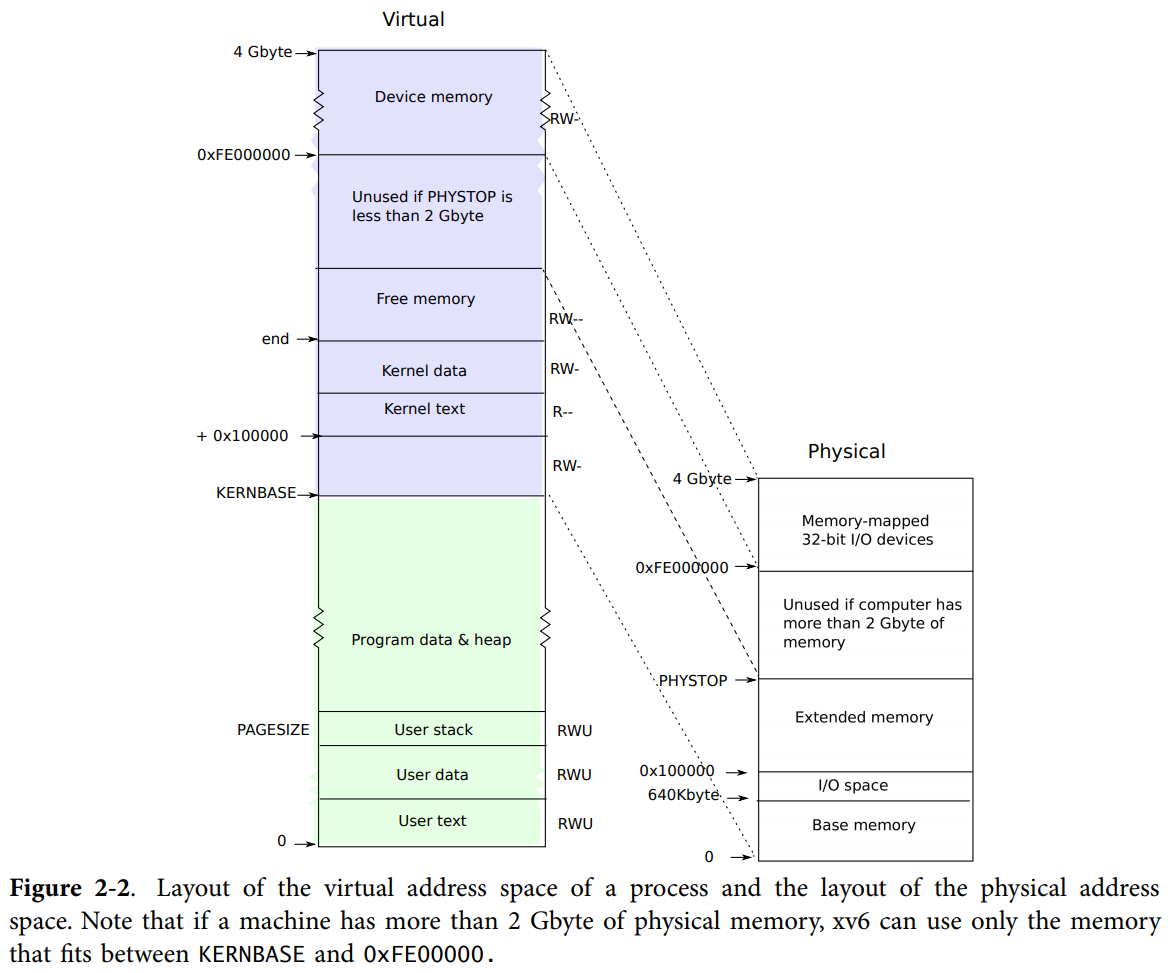
This chapter explains the code that sets up the kernel address space (paging) in xv6. The kernel VA–PA mapping is as in the diagram. The goal of the code explained here is to create that mapping.
Source: commentary/textbook
Every process has the kernel virtual address space set up. Each process gets 4 GB of virtual memory; from KERNBASE to 4 GB is reserved for the kernel. The kernel’s mapping between VA and PA is fixed as shown.
Sequence
Rough sequence with error handling omitted—useful to recall where each function is called from.
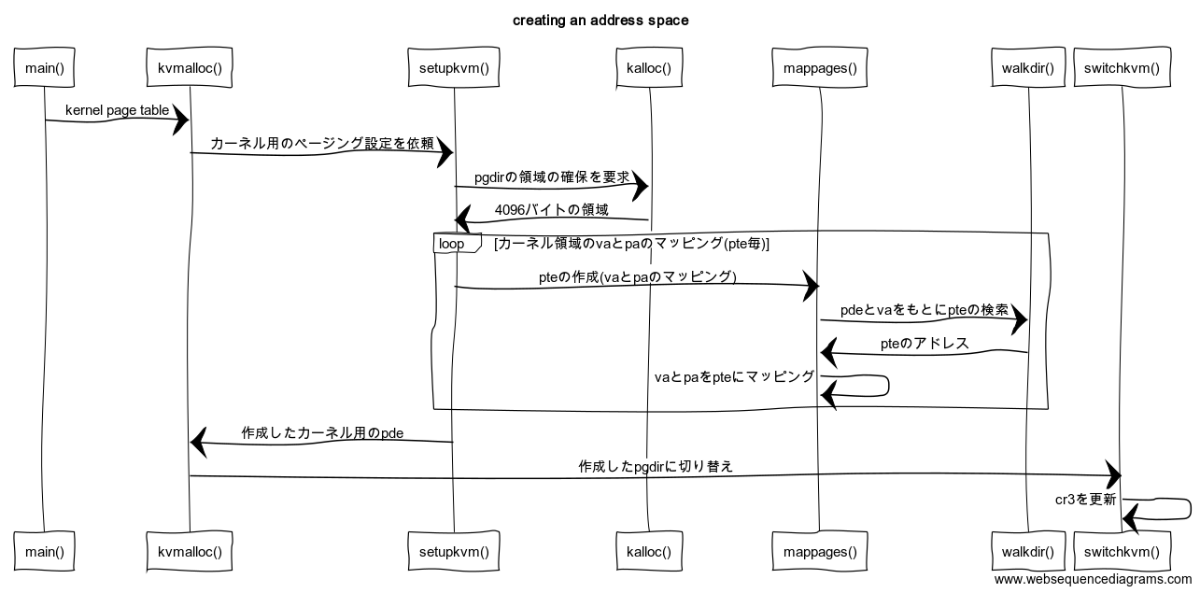
main()
Entry point.
main.c14 // Bootstrap processor starts running C code here. 15 // Allocate a real stack and switch to it, first 16 // doing some setup required for memory allocator to work. 17 int 18 main(void) 19 { 20 kinit1(end, P2V(4*1024*1024)); // phys page allocator 21 kvmalloc(); // kernel page table ~~~ 37 mpmain(); // finish this processor's setup 38 }L21: Create the kernel page table.
kvmalloc()
Create the kernel page table and switch to it.
Only one page-directory entry is created.
setupkvm() returns a PDE, but you can view it as the start of a PDT.
vm.c138 // Allocate one page table for the machine for the kernel address 139 // space for scheduler processes. 140 void 141 kvmalloc(void) 142 { 143 kpgdir = setupkvm(); 144 switchkvm(); 145 }
switchkvm()
Switch to the kernel page table.
vm.c147 // Switch h/w page table register to the kernel-only page table, 148 // for when no process is running. 149 void 150 switchkvm(void) 151 { 152 lcr3(V2P(kpgdir)); // switch to the kernel page table 153 }L152: Update the
cr3register.- Changing
cr3changes the PDT, i.e., the address space. - Switching
cr3to another page directory is equivalent to switching process spaces.cr3just needs to point topde[0].
- Changing
V2P()
memlayout.h8 #define KERNBASE 0x80000000 // First kernel virtual address ~~~ 11 #define V2P(a) (((uint) (a)) - KERNBASE)L11: Kernel physical memory location is hard-coded/known.
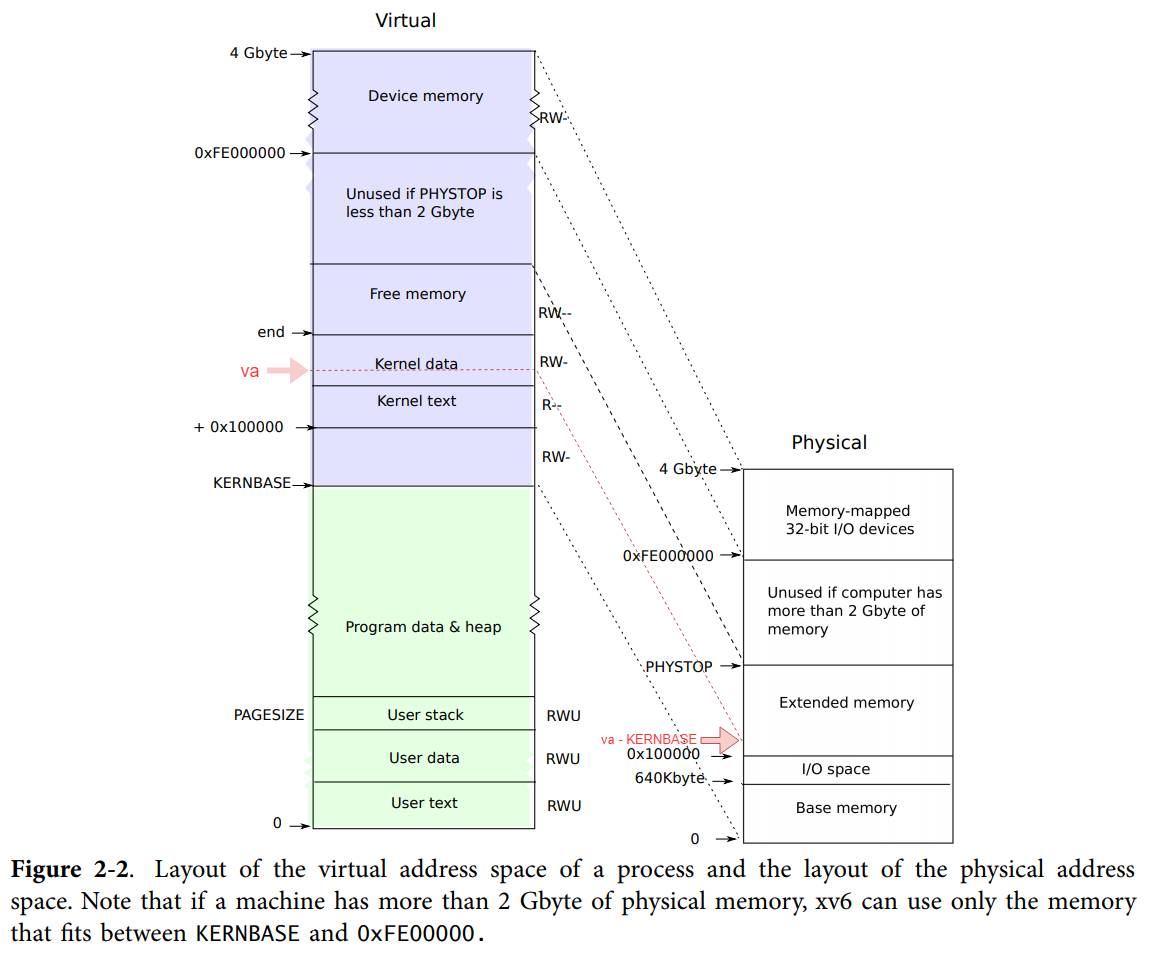
Source: commentary/textbook + red annotations
setupkvm()
Create the kernel’s PDEs.
vm.c103 // This table defines the kernel's mappings, which are present in 104 // every process's page table. 105 static struct kmap { 106 void *virt; 107 uint phys_start; 108 uint phys_end; 109 int perm; 110 } kmap[] = { 111 { (void*)KERNBASE, 0, EXTMEM, PTE_W}, // I/O space 112 { (void*)KERNLINK, V2P(KERNLINK), V2P(data), 0}, // kern text+rodata 113 { (void*)data, V2P(data), PHYSTOP, PTE_W}, // kern data+memory 114 { (void*)DEVSPACE, DEVSPACE, 0, PTE_W}, // more devices 115 }; 116 117 // Set up kernel part of a page table. 118 pde_t* 119 setupkvm(void) 120 { 121 pde_t *pgdir; 122 struct kmap *k; 123 124 if((pgdir = (pde_t*)kalloc()) == 0) 125 return 0; 126 memset(pgdir, 0, PGSIZE); 127 if (P2V(PHYSTOP) > (void*)DEVSPACE) 128 panic("PHYSTOP too high"); 129 for(k = kmap; k < &kmap[NELEM(kmap)]; k++) 130 if(mappages(pgdir, k->virt, k->phys_end - k->phys_start, 131 (uint)k->phys_start, k->perm) < 0) { 132 freevm(pgdir); 133 return 0; 134 } 135 return pgdir; 136 }L105-115:
kmap[]defines the kernel mappings—compare with the memory layout figure (Fig 2.2).L124-126: Allocate space for
pgdir.- 4096/32 = 128 PTE-sized slots; only four entries are used (
kmap[]). kalloc(): the kernel tracks free pages infreelist(details next chapter).kalloc.c79 // Allocate one 4096-byte page of physical memory. 80 // Returns a pointer that the kernel can use. 81 // Returns 0 if the memory cannot be allocated. 82 char* 83 kalloc(void) 84 { 85 struct run *r; 86 87 if(kmem.use_lock) 88 acquire(&kmem.lock); 89 r = kmem.freelist; 90 if(r) 91 kmem.freelist = r->next; 92 if(kmem.use_lock) 93 release(&kmem.lock); 94 return (char*)r; 95 }
- 4096/32 = 128 PTE-sized slots; only four entries are used (
L129-134: Fill
pgdiraccording tokmap[].
mappages()
Link virtual and physical addresses.
vm.c57 // Create PTEs for virtual addresses starting at va that refer to 58 // physical addresses starting at pa. va and size might not 59 // be page-aligned. 60 static int 61 mappages(pde_t *pgdir, void *va, uint size, uint pa, int perm) 62 { 63 char *a, *last; 64 pte_t *pte; 65 66 a = (char*)PGROUNDDOWN((uint)va); 67 last = (char*)PGROUNDDOWN(((uint)va) + size - 1); 68 for(;;){ 69 if((pte = walkpgdir(pgdir, a, 1)) == 0) 70 return -1; 71 if(*pte & PTE_P) 72 panic("remap"); 73 *pte = pa | perm | PTE_P; 74 if(a == last) 75 break; 76 a += PGSIZE; 77 pa += PGSIZE; 78 } 79 return 0; 80 }Args:
pgdir: page directory table baseva: virtual addresssize: size to mappa: physical addressperm: permission
L66-67: Align to PGSIZE (e.g.,
PGROUNDDOWN(8193)-> 8192).L69: Find the PTE for
va.L73: Update the PTE (
pa+perm).|overwrites the lower 12 bits ofpa(4*3 = 12 bytes).mmu.h93 // Page table/directory entry flags. 94 #define PTE_P 0x001 // Present 95 #define PTE_W 0x002 // Writeable 96 #define PTE_U 0x004 // User 97 #define PTE_PS 0x080 // Page Size
L76-77: Step by
PGSIZEand repeat.
walkpgdir()
Find the PTE in pgdir corresponding to va.
vm.c32 // Return the address of the PTE in page table pgdir 33 // that corresponds to virtual address va. If alloc!=0, 34 // create any required page table pages. 35 static pte_t * 36 walkpgdir(pde_t *pgdir, const void *va, int alloc) 37 { 38 pde_t *pde; 39 pte_t *pgtab; 40 41 pde = &pgdir[PDX(va)]; 42 if(*pde & PTE_P){ 43 pgtab = (pte_t*)P2V(PTE_ADDR(*pde)); 44 } else { 45 if(!alloc || (pgtab = (pte_t*)kalloc()) == 0) 46 return 0; 47 // Make sure all those PTE_P bits are zero. 48 memset(pgtab, 0, PGSIZE); 49 // The permissions here are overly generous, but they can 50 // be further restricted by the permissions in the page table 51 // entries, if necessary. 52 *pde = V2P(pgtab) | PTE_P | PTE_W | PTE_U; 53 } 54 return &pgtab[PTX(va)]; }L41: Get the PDE.
mmu.h65 // A virtual address 'la' has a three-part structure as follows: 66 // 67 // +--------10------+-------10-------+---------12----------+ 68 // | Page Directory | Page Table | Offset within Page | 69 // | Index | Index | | 70 // +----------------+----------------+---------------------+ 71 // \--- PDX(va) --/ \--- PTX(va) --/ 73 // page directory index 74 #define PDX(va) (((uint)(va) >> PDXSHIFT) & 0x3FF) 76 // page table index 77 #define PTX(va) (((uint)(va) >> PTXSHIFT) & 0x3FF) ~~~ 87 #define PTXSHIFT 12 // offset of PTX in a linear address 88 #define PDXSHIFT 22 // offset of PDX in a linear addressL67-71: Structure of a virtual address: first 10 bits = PDE index; next 10 bits = PTE index.
pgdir[PDX(va)]: find the PDE.pgtab[PTX(va)]: find the PTE.
L42-43: When the PDE exists:
mmu.h99 // Address in page table or page directory entry 100 #define PTE_ADDR(pte) ((uint)(pte) & ~0xFFF)
Source: “Paging #1: Page, PTE, PDE”
L44-53: If
allocis true, create a new page table and updatepde.
Summary
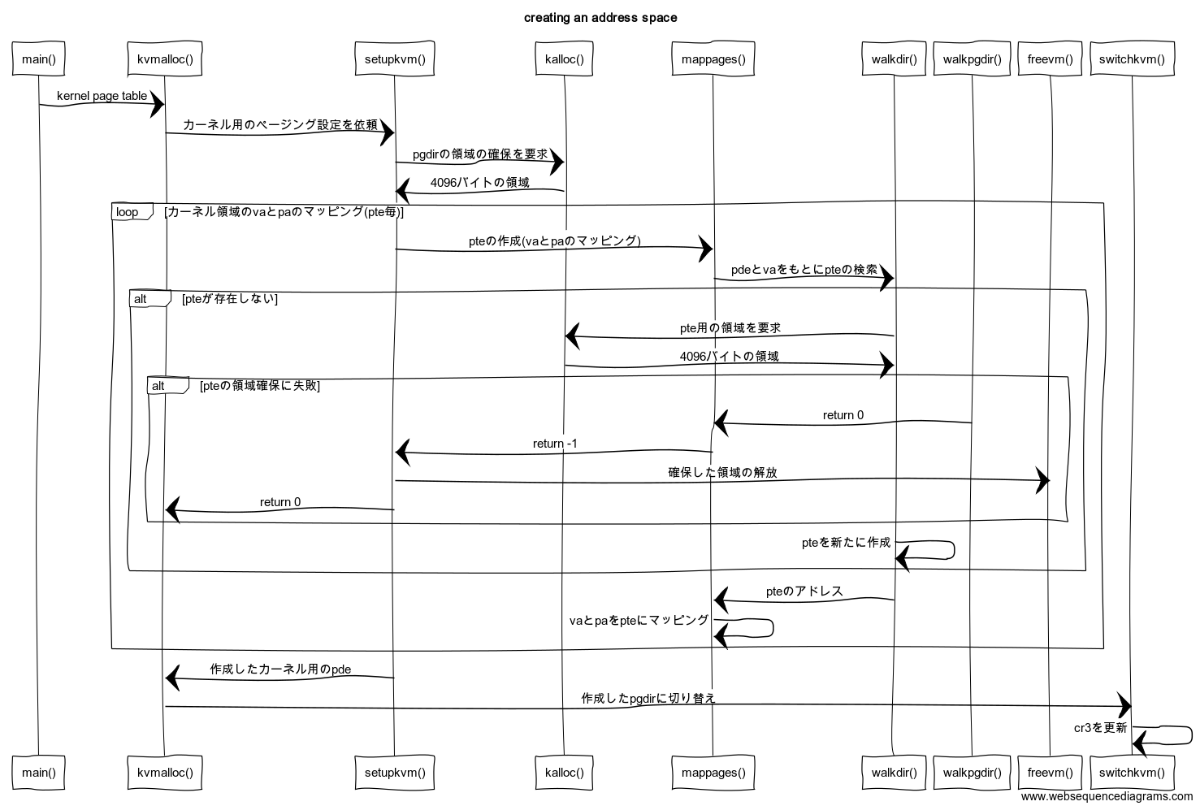
If you have comments or corrections, please contact me on Twitter or open an Issue.