xv6 Deep Dive table of contents
Previous post
Next post
Code: Physical memory allocator
Big picture
- Register physical memory, page by page, in the linked list
freelist(kinit1(), kinit2()).kalloc.c16 struct run { 17 struct run *next; 18 }; 20 struct { 21 struct spinlock lock; 22 int use_lock; 23 struct run *freelist; 24 } kmem;
- Provide pages to whoever asks (kalloc()).
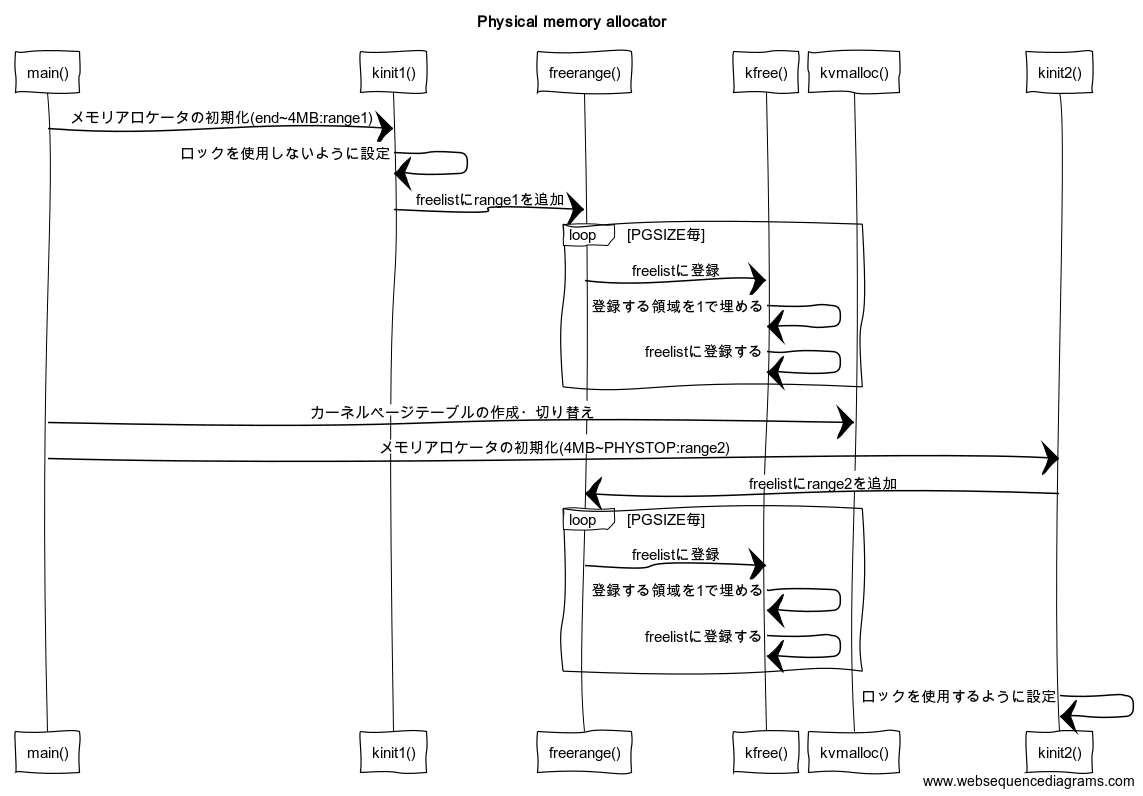
Sequence diagram
Rough flow. If you get lost inside the functions, glance here.
Memory layout (reprint)
The layout from the previous post; we use it a lot here.
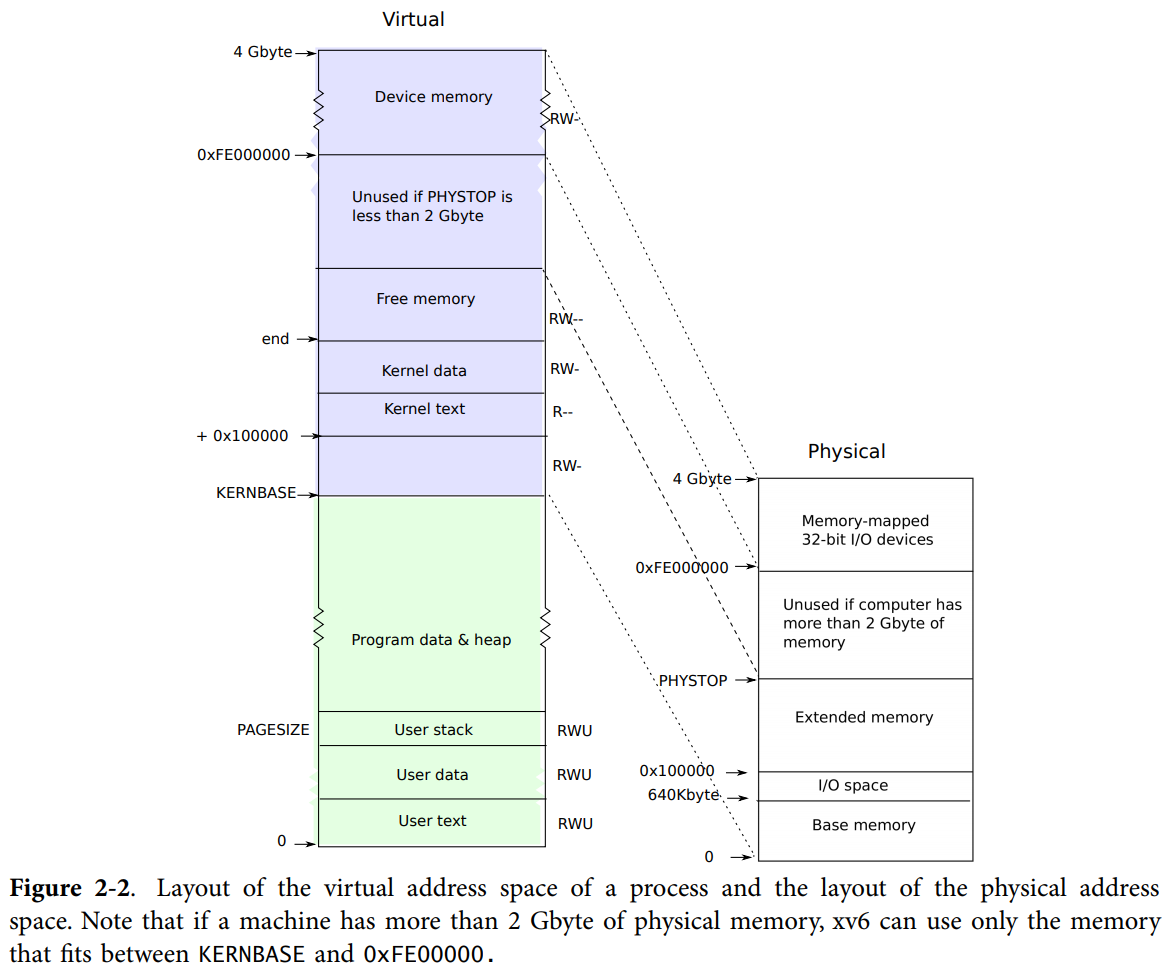
Source: commentary/textbook
Relationship between VA and PA:
| Name | Virtual address | Physical address |
|---|---|---|
| end | end | V2P(end) |
| PHYSTOP | P2V(PHYSTOP) | PHYSTOP |
| KERNBASE | KERNBASE | V2P(KERNBASE) |
main()
main.c17 int 18 main(void) 19 { 20 kinit1(end, P2V(4*1024*1024)); // phys page allocator 21 kvmalloc(); // kernel page table ~~~ 35 kinit2(P2V(4*1024*1024), P2V(PHYSTOP)); // must come after startothers() ~~~ 38 }- L20: Register end–4 MB with the page allocator.
- Up to L20 the PDT is
entrypgdir:main.c97 // The boot page table used in entry.S and entryother.S. 98 // Page directories (and page tables) must start on page boundaries, 99 // hence the __aligned__ attribute. 100 // PTE_PS in a page directory entry enables 4Mbyte pages. 102 __attribute__((__aligned__(PGSIZE))) 103 pde_t entrypgdir[NPDENTRIES] = { 104 // Map VA's [0, 4MB) to PA's [0, 4MB) 105 [0] = (0) | PTE_P | PTE_W | PTE_PS, 106 // Map VA's [KERNBASE, KERNBASE+4MB) to PA's [0, 4MB) 107 [KERNBASE>>PDXSHIFT] = (0) | PTE_P | PTE_W | PTE_PS, 108 };- L105: VA [0, 4 MB) -> PA [0, 4 MB)
- L106: VA [KERNBASE, KERNBASE+4 MB) -> PA [0, 4 MB) — both map to the same PA.
- L21: Create and install the kernel PDT.
- L22: Register 4 MB–PHYSTOP with the allocator.
- Why split into kinit1() and kinit2()?
entry.Sonly maps physical 0–4 MB, so only that range is usable at first.kinit1()plus laterkvmalloc()sets up the real paging (needs allocator—bootstrap issue).kinit2()then registers everything above 4 MB.
kinit1()
kalloc.c26 // Initialization happens in two phases. 27 // 1. main() calls kinit1() while still using entrypgdir to place just 28 // the pages mapped by entrypgdir on free list. 29 // 2. main() calls kinit2() with the rest of the physical pages 30 // after installing a full page table that maps them on all cores. 31 void 32 kinit1(void *vstart, void *vend) 33 { 34 initlock(&kmem.lock, "kmem"); 35 kmem.use_lock = 0; 36 freerange(vstart, vend); }vstart: end,vend: P2V(410241024)- L34-35: Initialize lock but leave it off (locking needs the allocator, so can’t use yet).
- L36: Register the region (
vstart–vend) infreelist.
freerange()
kalloc.c46 void 47 freerange(void *vstart, void *vend) 48 { 49 char *p; 50 p = (char*)PGROUNDUP((uint)vstart); 51 for(; p + PGSIZE <= (char*)vend; p += PGSIZE) 52 kfree(p); }- L50: Align to PGSIZE.
- L51-52: Call kfree() for each page.
kfree()
Remove the page (start address) from freelist.
kalloc.c54 //PAGEBREAK: 21 55 // Free the page of physical memory pointed at by v, 56 // which normally should have been returned by a 57 // call to kalloc(). (The exception is when 58 // initializing the allocator; see kinit above.) 59 void 60 kfree(char *v) 61 { 62 struct run *r; 64 if((uint)v % PGSIZE || v < end || V2P(v) >= PHYSTOP) 65 panic("kfree"); 67 // Fill with junk to catch dangling refs. 68 memset(v, 1, PGSIZE); 70 if(kmem.use_lock) 71 acquire(&kmem.lock); 72 r = (struct run*)v; 73 r->next = kmem.freelist; 74 kmem.freelist = r; 75 if(kmem.use_lock) 76 release(&kmem.lock); }- L64: Error checks—
vmust be PGSIZE-aligned and within free memory (end–P2V(PHYSTOP)). - L68: Fill with 1s up to
v+PGSIZE. - L72-74: Add
vtofreelist. - L70-71, L75-76: Locking (to avoid corrupting the list).
- L64: Error checks—
kinit2()
kalloc.c39 void 40 kinit2(void *vstart, void *vend) 41 { 42 freerange(vstart, vend); 43 kmem.use_lock = 1; }- L42: Register physical 4 MB–PHYSTOP in the free list.
- L43: Enable locking (see Locking for details).
kalloc()
Provide a physical page (PGSIZE).
kalloc.c79 // Allocate one 4096-byte page of physical memory. 80 // Returns a pointer that the kernel can use. 81 // Returns 0 if the memory cannot be allocated. 82 char* 83 kalloc(void) 84 { 85 struct run *r; 87 if(kmem.use_lock) 88 acquire(&kmem.lock); 89 r = kmem.freelist; 90 if(r) 91 kmem.freelist = r->next; 92 if(kmem.use_lock) 93 release(&kmem.lock); 94 return (char*)r; }- L89-91: Pop one from
freelist. - L87-88, L92-93: Locking.
- L89-91: Pop one from
Code: sbrk
sys_sbrk()
System call to grow/shrink the current process’s memory size.
sysproc.c45 int 46 sys_sbrk(void) 47 { 48 int addr; 49 int n; 51 if(argint(0, &n) < 0) 52 return -1; 53 addr = myproc()->sz; 54 if(growproc(n) < 0) 55 return -1; 56 return addr; }- L51-52: Parse the argument (details later).
- L54: Grow memory (growproc()).
growproc()
Increase memory allocated to the running process (i.e., add paging entries).
proc.c156 // Grow current process's memory by n bytes. 157 // Return 0 on success, -1 on failure. 158 int 159 growproc(int n) 160 { 161 uint sz; 162 struct proc *curproc = myproc(); 164 sz = curproc->sz; 165 if(n > 0){ 166 if((sz = allocuvm(curproc->pgdir, sz, sz + n)) == 0) 167 return -1; 168 } else if(n < 0){ 169 if((sz = deallocuvm(curproc->pgdir, sz, sz + n)) == 0) 170 return -1; 171 } 172 curproc->sz = sz; 173 switchuvm(curproc); 174 return 0; }- L162: Get current process.
- L165-167: Growing memory (allocuvm()).
- L168-171: Shrinking memory (deallocuvm()).
deallocuvm()
Remove allocated physical memory from freelist.
vm.c251 // Deallocate user pages to bring the process size from oldsz to 252 // newsz. oldsz and newsz need not be page-aligned, nor does newsz 253 // need to be less than oldsz. oldsz can be larger than the actual 254 // process size. Returns the new process size. 255 int 256 deallocuvm(pde_t *pgdir, uint oldsz, uint newsz) 257 { 258 pte_t *pte; 259 uint a, pa; 261 if(newsz >= oldsz) 262 return oldsz; 264 a = PGROUNDUP(newsz); 265 for(; a < oldsz; a += PGSIZE){ 266 pte = walkpgdir(pgdir, (char*)a, 0); 267 if(!pte) 268 a = PGADDR(PDX(a) + 1, 0, 0) - PGSIZE; 269 else if((*pte & PTE_P) != 0){ 270 pa = PTE_ADDR(*pte); 271 if(pa == 0) 272 panic("kfree"); 273 char *v = P2V(pa); 274 kfree(v); 275 *pte = 0; 276 } 277 } 278 return newsz; }L264: Align to PGSIZE.
L266: Look up the PTE. User virtual addresses start at 0, so
oldsz/newszare VAs. Because the third argument is 0, walkpgdir() won’t allocate if absent.L267-268: If the PTE is missing:
PDX(a)+1is the next PDE index;PGADDR(PDX(a)+1,0,0)-PGSIZEis the address just before that next PDE’s range (minus PGSIZE because the loop adds PGSIZE next).L269-275: If the PTE exists and
PTE_P(page present) is set.L270: Physical page start address (
PTE_ADDR).99 // Address in page table or page directory entry 100 #define PTE_ADDR(pte) ((uint)(pte) & ~0xFFF) 101 #define PTE_FLAGS(pte) ((uint)(pte) & 0xFFF)L271-272, L275: If
pais zero that’s an error (initial PTEs are zero).L273:
freelistis managed in kernel space, soP2V()is usable.L274: Free the physical page.
allocuvm()
Allocate new physical memory.
vm.c219 // Allocate page tables and physical memory to grow process from oldsz to 220 // newsz, which need not be page aligned. Returns new size or 0 on error. 221 int 222 allocuvm(pde_t *pgdir, uint oldsz, uint newsz) 223 { 224 char *mem; 225 uint a; 227 if(newsz >= KERNBASE) 228 return 0; 229 if(newsz < oldsz) 230 return oldsz; 232 a = PGROUNDUP(oldsz); 233 for(; a < newsz; a += PGSIZE){ 234 mem = kalloc(); 235 if(mem == 0){ 236 cprintf("allocuvm out of memory\n"); 237 deallocuvm(pgdir, newsz, oldsz); 238 return 0; 239 } 240 memset(mem, 0, PGSIZE); 241 if(mappages(pgdir, (char*)a, PGSIZE, V2P(mem), PTE_W|PTE_U) < 0){ 242 cprintf("allocuvm out of memory (2)\n"); 243 deallocuvm(pgdir, newsz, oldsz); 244 kfree(mem); 245 return 0; 246 } 247 } 248 return newsz; }- L227-230: Error checks.
- L232: Align to PGSIZE.
- L233-247: Allocate as many pages as needed.
- L234: Get a physical page (kalloc()).
- L234-239: If no memory left.
- L240: Zero-initialize.
- L241-246: Map the VA to the physical page (uses mappages(), deallocuvm(), kfree()).
Code: exec
System call to build the user address space.
exec.c10 int 11 exec(char *path, char **argv) 12 { 13 char *s, *last; 14 int i, off; 15 uint argc, sz, sp, ustack[3+MAXARG+1]; 16 struct elfhdr elf; 17 struct inode *ip; 18 struct proghdr ph; 19 pde_t *pgdir, *oldpgdir; 20 struct proc *curproc = myproc(); ~~~ obtain inode for path 30 pgdir = 0; 32 // Check ELF header ~~~ validate ELF 38 if((pgdir = setupkvm()) == 0) 39 goto bad; 41 // Load program into memory. 42 sz = 0; 43 for(i=0, off=elf.phoff; i<elf.phnum; i++, off+=sizeof(ph)){ 44 if(readi(ip, (char*)&ph, off, sizeof(ph)) != sizeof(ph)) 45 goto bad; ~~~ error checks 52 if((sz = allocuvm(pgdir, sz, ph.vaddr + ph.memsz)) == 0) 53 goto bad; 54 if(ph.vaddr % PGSIZE != 0) 55 goto bad; 56 if(loaduvm(pgdir, (char*)ph.vaddr, ip, ph.off, ph.filesz) < 0) 57 goto bad; 58 } ~~~ 63 // Allocate two pages at the next page boundary. 64 // Make the first inaccessible. Use the second as the user stack. 65 sz = PGROUNDUP(sz); 66 if((sz = allocuvm(pgdir, sz, sz + 2*PGSIZE)) == 0) 67 goto bad; 68 clearpteu(pgdir, (char*)(sz - 2*PGSIZE)); 69 sp = sz; 71 // Push argument strings, prepare rest of stack in ustack. ~~~ set up argv etc. 90 // Save program name for debugging. ~~~ misc for debugging 95 96 // Commit to the user image. 97 oldpgdir = curproc->pgdir; 98 curproc->pgdir = pgdir; ~~~ set various curproc fields 102 switchuvm(curproc); 103 freevm(oldpgdir); 104 return 0; 106 bad: ~~~ error handling- L38: Map the kernel portion of memory.
- L43-58: Load each ELF segment into memory.
- L52: Allocate physical memory:
sz= old size,ph.vaddr + ph.memsz= new size. - L56: Expand the inode data into the specified virtual address (loaduvm()).
- L65-67: Allocate two pages to properly catch overly large args that span pages.
- L68: Make the first of those two pages inaccessible to user mode.
vm.c300 // Clear PTE_U on a page. Used to create an inaccessible 301 // page beneath the user stack. 302 void 303 clearpteu(pde_t *pgdir, char *uva) 304 { 305 pte_t *pte; 307 pte = walkpgdir(pgdir, uva, 0); 308 if(pte == 0) 309 panic("clearpteu"); 310 *pte &= ~PTE_U; }- Uses walkpgdir().
- L97,103: Free previously allocated physical memory.
- L98: Install the newly built page table.
- L102: Switch to the new page table.
loaduvm()
Expand inode data into memory.
vm.c195 // Load a program segment into pgdir. addr must be page-aligned 196 // and the pages from addr to addr+sz must already be mapped. 197 int 198 loaduvm(pde_t *pgdir, char *addr, struct inode *ip, uint offset, uint sz) 199 { 200 uint i, pa, n; 201 pte_t *pte; 203 if((uint) addr % PGSIZE != 0) 204 panic("loaduvm: addr must be page aligned"); 205 for(i = 0; i < sz; i += PGSIZE){ 206 if((pte = walkpgdir(pgdir, addr+i, 0)) == 0) 207 panic("loaduvm: address should exist"); 208 pa = PTE_ADDR(*pte); 209 if(sz - i < PGSIZE) 210 n = sz - i; 211 else 212 n = PGSIZE; 213 if(readi(ip, P2V(pa), offset+i, n) != n) 214 return -1; 215 } 216 return 0; }- L203: Check alignment.
- L205-215: For each PGSIZE chunk, copy inode data into physical memory.
- L206-208: Find the physical address from the VA (walkpgdir()).
- L209-212: If less than a page remains, read only that much.
- L213-214: Copy data (details in the file-system chapter):
ipinode,P2V(pa)destination,offset+ioffset,nsize.
If you have comments or corrections, please contact me on Twitter or open an Issue.