xv6 Deep Dive table of contents
Previous post
Next post


This chapter introduces several special-purpose registers. I won’t explain each one here—see this excellent reference when needed.

Systems calls, exceptions, and interrupts

Three ways control moves from a user program into the kernel:

  1. System call
  2. Exception
  3. Interrupt / trap
  • Issued by the int instruction
  • Trap: caused by the currently running process
  • Interrupt: unrelated to the current process

x86 protection

Protection levels
Lower two bits of %cs are the CPL (Current Privilege Level).

  • DPL (Descriptor Privilege Level)
  • CPL (Current Privilege Level)

Level 0: kernel mode; Level 3: user mode.

IDT
Interrupt Descriptor Table: maps interrupts to handlers. The kernel must build this table. Great article (JP).

int handling

  • int n: triggers the nth IDT entry.

  • %cs and %eip are manipulated, so we must preserve them (e.g., push to stack).

  • Hardware steps for int:

    1. Fetch descriptor n from IDT.
    2. Check %cs CPL ≤ descriptor DPL.
    3. Only if target selector DPL ≤ CPL, save %esp and %ss (internal CPU regs).
    4. Load %ss/%esp from task segment descriptor.
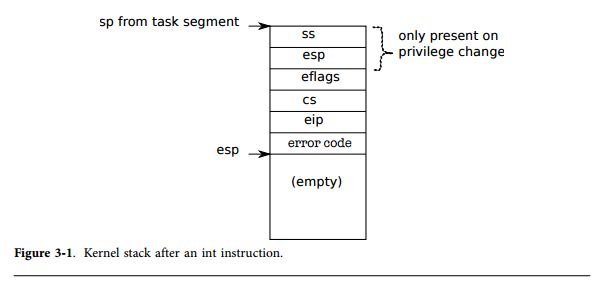
    5. Push %ss %esp %eflags %cs %eip onto the stack.
    6. Clear IF (interrupt-enable) in %eflags.
    7. Load %cs/%eip from the descriptor (set in Chapter 5’s switchuvm() via TSS).

    Stack state after int

    Stack state after int

    Source: commentary/textbook

iret (not ret) restores the stack created by int.

Code: Assembly trap handlers

tvinit() (called from main.c) sets the IDT.

  • trap.c

    17 void
    18 tvinit(void)
    19 {
    20   int i;
    
    22   for(i = 0; i < 256; i++)
    23     SETGATE(idt[i], 0, SEG_KCODE<<3, vectors[i], 0);
    24   SETGATE(idt[T_SYSCALL], 1, SEG_KCODE<<3, vectors[T_SYSCALL], DPL_USER);
    
    26   initlock(&tickslock, "time");
    27 } 
    
    • L22-23: Set all 256 IDT entries to handlers in vectors.

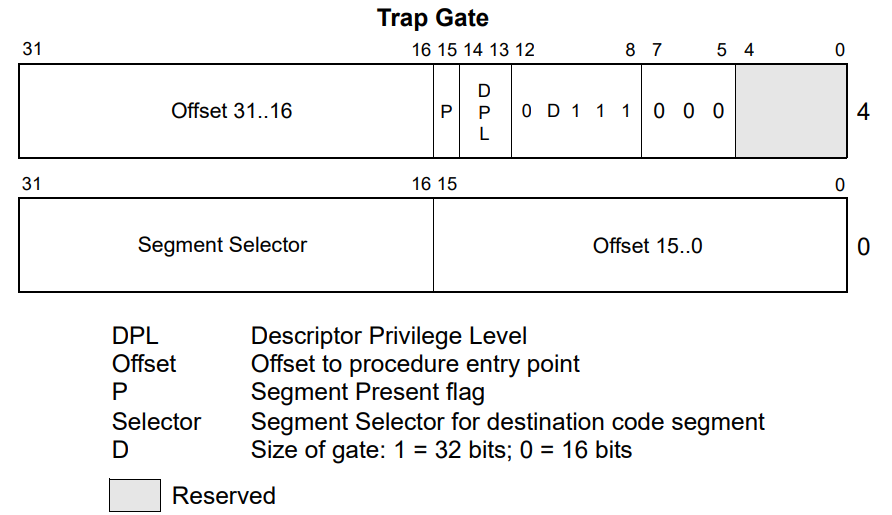
    • L24: Set system-call IDT entry. Only T_SYSCALL (entry 64) is callable from user (fourth arg is DPL_USER). Second arg 1 marks it as a trap gate.

      161 // - istrap: 1 for a trap (= exception) gate, 0 for an interrupt gate.
      162 //   interrupt gate clears FL_IF, trap gate leaves FL_IF alone
      163 // - sel: Code segment selector for interrupt/trap handler
      164 // - off: Offset in code segment for interrupt/trap handler
      165 // - dpl: Descriptor Privilege Level -
      166 //        privilege required to invoke via int instruction.
      #define SETGATE(gate, istrap, sel, off, d) ...
    • vectors.pl: Perl code generator that produces vectors.S (the vectors array).

      ``` perl
      29 # sample output:
      30 #   # handlers
      31 #   .globl alltraps
      32 #   .globl vector0
      33 #   vector0:
      34 #     pushl $0
      35 #     pushl $0
      36 #     jmp alltraps
      ```
      
      • L34: value for trapframe.err (CPU pushes for some traps, e.g., page fault).
      • L35: value for trapframe.trapno (used by trap() to dispatch).
      • L36: All vectors jump to alltraps.
    • mmu.h

      ``` c
      147 // Gate descriptors for interrupts and traps
      struct gatedesc { ... };
      ~~~
      #define SETGATE(gate, istrap, sel, off, d) ...
      ```
      > 
      Intel SDM Vol 3 Ch.6

      Intel SDM Vol 3 Ch.6

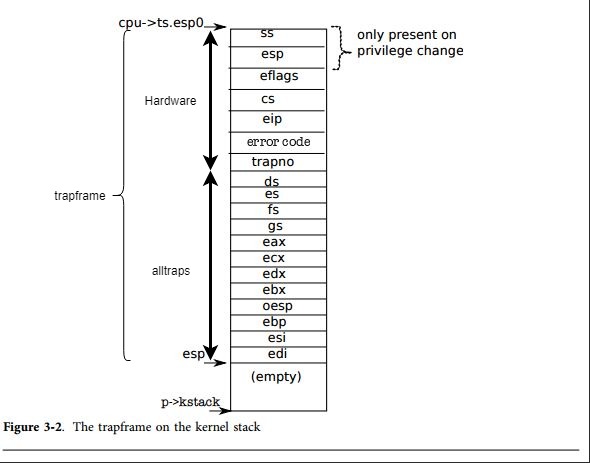
With the IDT set, next see what happens when a trap actually occurs. Every handler jumps to alltraps.

  • alltraps builds a trapframe on the stack, then calls trap() with it.
    • x86.h

      ``` c
      147 // Layout of the trap frame built on the stack ... passed to trap().
      struct trapframe {
        // pushed by pusha
        uint edi, esi, ebp, oesp, ebx, edx, ecx, eax;
        // rest
        ushort gs; ushort padding1; ushort fs; ushort padding2;
        ushort es; ushort padding3; ushort ds; ushort padding4;
        uint trapno;
        // by hardware
        uint err; uint eip; ushort cs; ushort padding5; uint es;
        // when crossing rings
        uint esp; ushort ss; ushort padding6;
      };
      ```
      By the time `alltraps` runs, everything from `ss` up through `trapno` is already on the stack.
      
    • trapasm.S

      ``` c
       3   # vectors.S sends all traps here.
       4 .globl alltraps
       5 alltraps:
       6   # Build trap frame.
       7   pushl %ds
       8   pushl %es
       9   pushl %fs
      10   pushl %gs
      11   pushal
      
      13   # Set up data segments.
      14   movw $(SEG_KDATA<<3), %ax
      15   movw %ax, %ds
      16   movw %ax, %es
      
      18   # Call trap(tf), where tf=%esp
      19   pushl %esp
      20   call trap
      21   addl $4, %esp
      
      23   # Return falls through to trapret...
      24 .globl trapret
      25 trapret:
      26   popal
      27   popl %gs
      28   popl %fs
      29   popl %es
      30   popl %ds
      31   addl $0x8, %esp  # trapno and errcode
      32   iret
      ```
      - L6-11: Build the rest of the `trapframe`.
      - L15-16: Set data segments (`%ds`, `%es`).
      
        > 
      Stack after L16

      Stack after L16

      Source: [commentary/textbook](https://pdos.csail.mit.edu/6.828/2018/xv6/book-rev11.pdf) - L18-20: Call `trap()` with pointer to the built `trapframe` (`%esp`). - L26-30: Pop what was pushed at L6-11. - L31: Skip `trapno` and `errcode`. - L32: `iret` — pops `%cs` `%eip` `%eflags` `%esp` `%ss` (for ring changes) and resumes the interrupted program.

Code: C trap handler

  • trap() — called from alltraps.

    36 void
    37 trap(struct trapframe *tf)
    38 {
    39   if(tf->trapno == T_SYSCALL){
    40     if(myproc()->killed)
    41       exit();
    42     myproc()->tf = tf;
    43     syscall();
    44     if(myproc()->killed)
    45       exit();
    46     return;
    47   }
    
    50   switch(tf->trapno){
                .
                .
                .

    Dispatch based on trapno pushed by the IDT handler.

Code: System calls

Here we follow the system-call path from trap(). First, how the very first system call is made (see “Code: The first system call”).

  • initcode.S

    8 # exec(init, argv)
    9 .globl start
    10 start:
    11   pushl $argv
    12   pushl $init
    13   pushl $0  // where caller pc would be
    14   movl $SYS_exec, %eax
    15   int $T_SYSCALL
    • L11-12: Push arguments.
    • L13: Push return address for the syscall. This first syscall never returns, so any value is fine (call would normally push it automatically).
    • L14: Put syscall number in %eax.
    • L15: Trigger syscall with int.

From trap() the flow enters syscall().

  • syscall.c

    131 void
    132 syscall(void)
    133 {
    134   int num;
    135   struct proc *curproc = myproc();
    
    137   num = curproc->tf->eax;
    138   if(num > 0 && num < NELEM(syscalls) && syscalls[num]) {
    139     curproc->tf->eax = syscalls[num]();
    140   } else {
    141     cprintf("%d %s: unknown sys call %d\n",
    142             curproc->pid, curproc->name, num);
    143     curproc->tf->eax = -1;
    144   }
    }
    • L137: Take the syscall number from %eax in the trapframe.

    • L139/143: Place the return value in %eax (syscall return register). L143 handles unknown syscalls.

      ``` c
      107 static int (*syscalls[])(void) = {
      108 [SYS_fork]    sys_fork,
      109 [SYS_exit]    sys_exit,
      110 [SYS_wait]    sys_wait,
      111 [SYS_pipe]    sys_pipe,
      112 [SYS_read]    sys_read,
      113 [SYS_kill]    sys_kill,
      114 [SYS_exec]    sys_exec,
                  ...
      ```
      
  • Helper for args: argint()
    Syscall arguments are on the user stack (tf->esp). Example usage:

      ``` c
      286 int
      287 sys_open(void)
      288 {
      289   char *path;
      290   int fd, omode;
      291   struct file *f;
      292   struct inode *ip;
    
      294   if(argstr(0, &path) < 0 || argint(1, &omode) < 0)
      295     return -1;
      ```
      - First argument is the index, second is where to store the value.
    
    • syscall.c

      ``` c
      48 // Fetch the nth 32-bit system call argument.
      49 int
      50 argint(int n, int *ip)
      51 {
      52   return fetchint((myproc()->tf->esp) + 4 + 4*n, ip);
      }
      ``` 
      - `+4`: skip return address pushed by `call`.
      - `+4*n`: advance to the nth argument.
      
    • syscall.c

      ``` c
      16 // Fetch the int at addr from the current process.
      17 int
      18 fetchint(uint addr, int *ip)
      19 {
      20   struct proc *curproc = myproc();
      
      22   if(addr >= curproc->sz || addr+4 > curproc->sz)
      23     return -1;
      24   *ip = *(int*)(addr);
      25   return 0;
      }
      ```
      
      • L22: Validate user-space address.
      • L24: Read it.
  • Other helpers include argptr(), argstr(), argfd().

Exercises

My answer to the exercise in the commentary/textbook:

Add a new system call to get the current UTC time and return it to the user program. You may want to use the helper function cmostime (7552) to read the real-time clock. The file date.h contains the definition of struct rtcdate (0950), which you will provide as an argument to cmostime as a pointer.
Answer gist

Next time we’ll follow what happens when trap() handles an interrupt and look at drivers.


If you have comments or corrections, please contact me on Twitter or open an Issue.